ai
AI-driven
AI-for-business

Quick Answer: Choose an AI consultant who asks about your business problems first — not the technology — has proven delivery experience in your industry, stores data in Australian data centers, and offers both strategy AND implementation support. Ask for case studies, check references, and ensure you own all IP.
The AI gold rush is well and truly here. From boardrooms in Brisbane to executive floors in Sydney, every business leader is asking the same question: how do we actually use AI to move the needle?
The answer, for most organisations, starts with finding the right AI consultant. But here's the problem — the market is flooded. A quick search turns up hundreds of firms all promising "AI transformation," and the stakes of choosing wrong are painfully high. Australian businesses routinely waste anywhere from $50,000 to $200,000 on consultants who overpromise, underdeliver, and leave behind little more than a slide deck and a hefty invoice.
Generated with Diagram Generator AI
This guide will help you cut through the noise. Whether you're a CTO evaluating vendors, a CEO exploring your first AI initiative, or a product leader trying to modernise your operations, you'll walk away knowing exactly what to look for — and what to avoid — when hiring an AI consultant in Australia.
There's a widening gap between the hype around AI and the reality of implementing it. According to CSIRO's AI Roadmap, Australia has the potential to boost its economy by $315 billion through AI adoption by 2028 — yet many businesses still struggle to move beyond pilot projects.
The core issue isn't a lack of ambition. It's a lack of specialised expertise. Most internal teams, no matter how talented, weren't built to design AI systems from scratch. They know your business inside and out, but machine learning pipelines, retrieval-augmented generation architectures, and model fine-tuning sit well outside their day-to-day responsibilities.
This is where the right consultant earns their fee. A good AI consultant doesn't just build technology — they help you avoid the $100,000+ mistakes that come from choosing the wrong solution, the wrong vendor, or the wrong problem to solve in the first place. They help you navigate a fragmented vendor landscape where every platform claims to be the answer, and they translate your business goals into technical reality. Whether you're looking to automate document processing, build a customer service chatbot, or deploy predictive analytics across your operations, the right advisor turns ambiguity into a clear, executable plan.
Before we talk about what to look for, let's talk about who to walk away from. Certain patterns should immediately raise your guard.
Be cautious of any consultant who promises "AI transformation" in the first meeting without asking a single question about your data. If they lead with technology — pitching specific models or platforms — before understanding your business problems, they're selling solutions in search of a problem. Watch out for firms that deliver beautifully formatted strategy documents but have no capacity or intention to help you implement anything. Strategy without execution is just expensive shelf-ware.
A trustworthy consultant will also be upfront about AI's limitations. If they can't articulate scenarios where AI is not the right answer, they lack either the honesty or the experience you need. Finally, be wary of proprietary platforms. If your consultant's solution locks you into their ecosystem with ongoing licensing fees and no path to independence, you're not hiring a partner — you're acquiring a dependency.
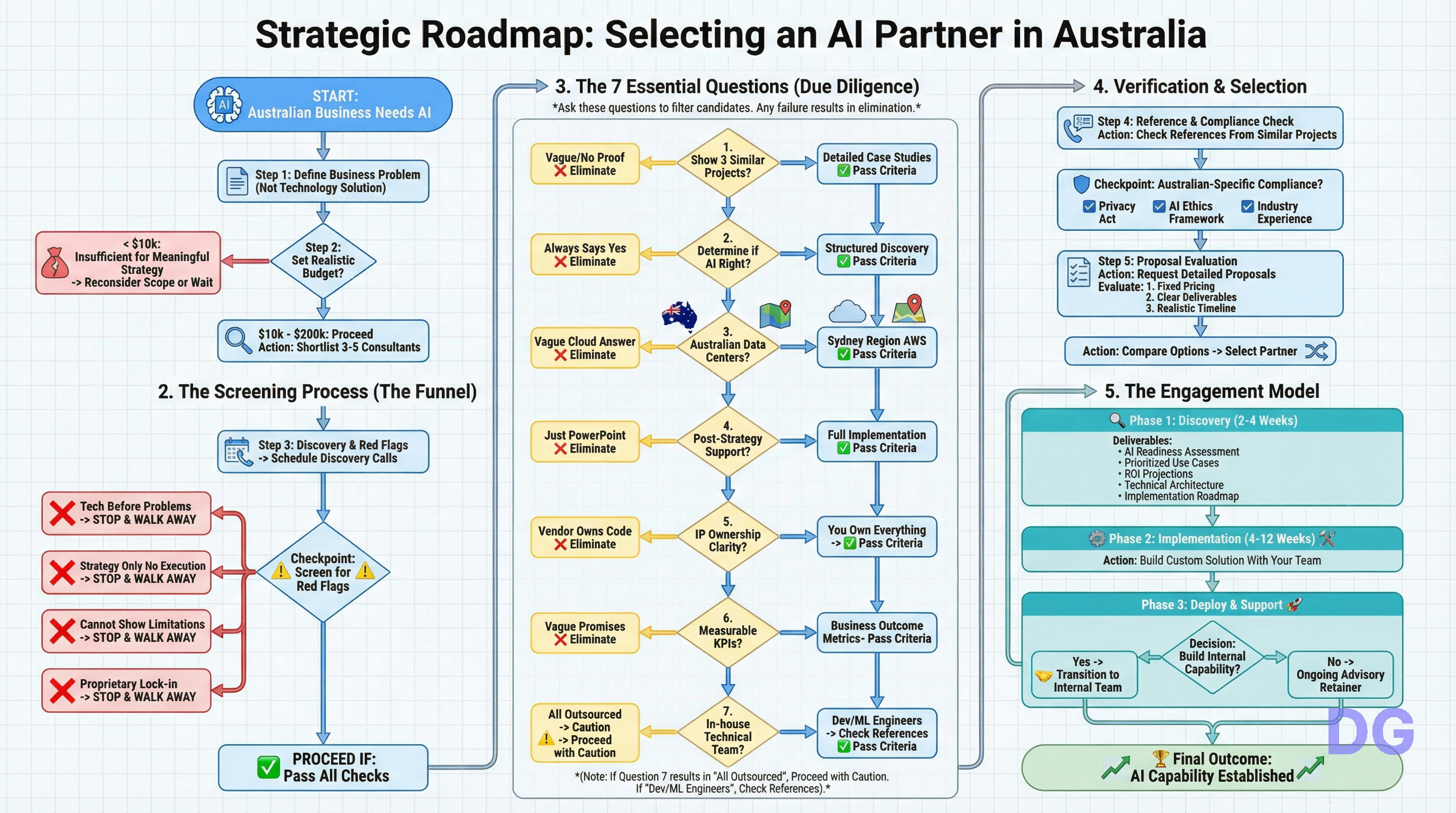
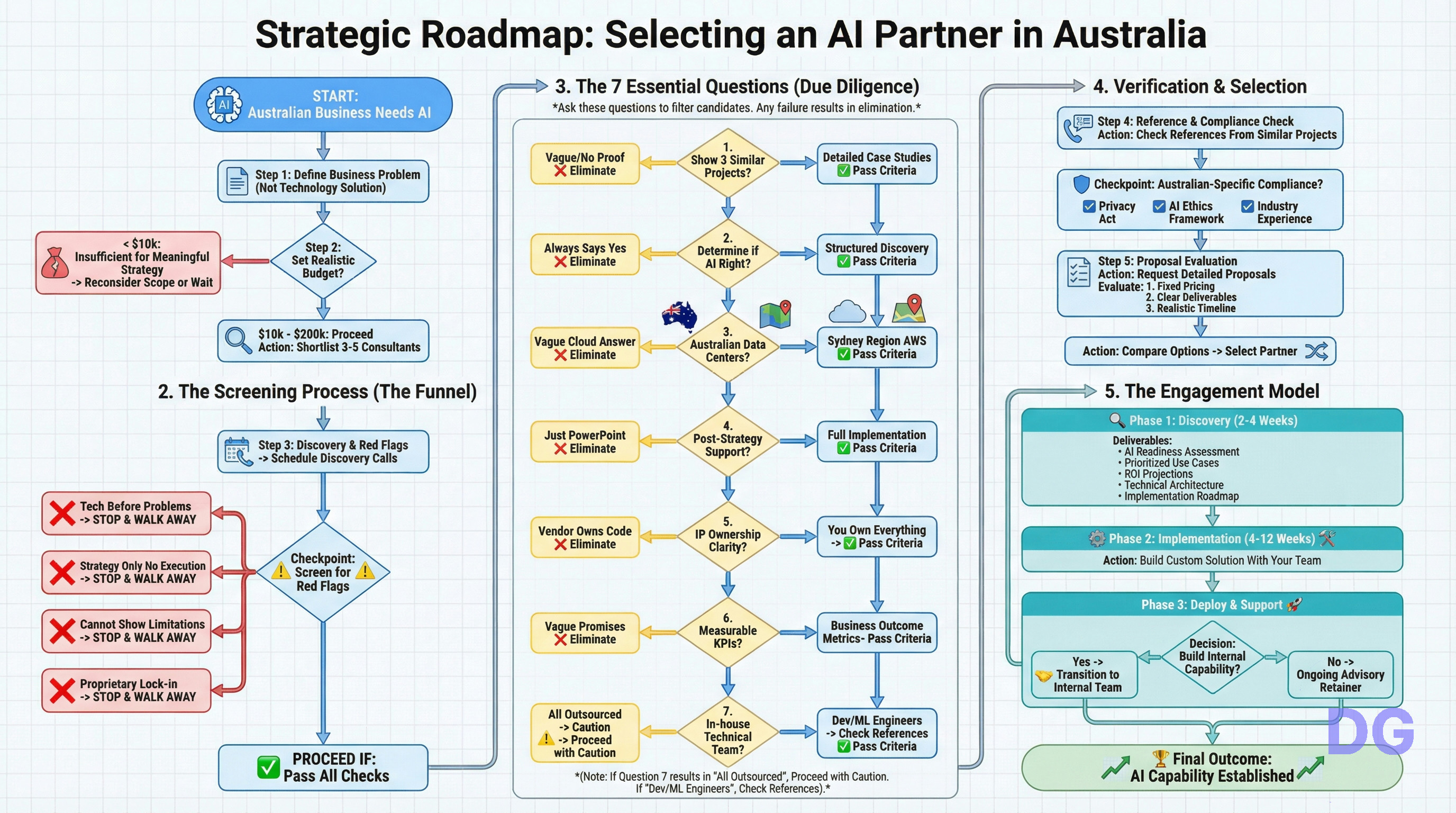
The difference between a great engagement and a costly mistake often comes down to the questions you ask before signing. Here are seven that will separate genuine experts from polished salespeople.
This is the single most important question you can ask, and the one most businesses skip. Proof of delivery matters far more than promises. You want to see projects in a similar industry, at a similar scale, with measurable outcomes — not glossy case studies from Fortune 500 companies when your business has fifty employees.
Ask for specifics: what was the problem, what did they build, and what were the results? A consultant who has genuinely delivered will be able to walk you through the messy details — the challenges they encountered, the trade-offs they made, and the outcomes they achieved. If the answer is vague or overly polished, keep looking.
The best AI consultants are the ones willing to tell you not to use AI. A strong answer here involves a structured discovery process: understanding your current workflows, assessing your data readiness, evaluating feasibility, and considering simpler alternatives before recommending a machine learning approach.
If a consultant immediately jumps to AI without first understanding your processes, it signals a bias toward selling their services rather than solving your problem. Sometimes a well-designed automation, a better database query, or a streamlined manual process will deliver more value than any AI model.
Data sovereignty is not a buzzword — it's a legal and operational reality. For Australian businesses handling sensitive customer, financial, or health data, knowing exactly where your data resides is critical.
Look for consultants who can specify Australian data centres (such as AWS's Sydney region) and who have clear, documented privacy policies. They should be conversant with the Australian Privacy Act and be able to explain how their solutions comply with it. Vague answers about "the cloud" without specifics about regions, encryption, or access controls should give you pause.
This question exposes the difference between a consultant and a genuine partner. Many firms in the AI space are excellent at producing recommendations but have no capability — or interest — in helping you execute them.
The answer you want to hear involves implementation support, a technical team that can build what they've designed, and an ongoing relationship that extends beyond the final invoice. Look for engagement models that cover the full lifecycle: from strategy through development, testing, deployment, and post-launch support. If the deliverable is a PowerPoint deck and a handshake, you'll likely end up hiring someone else to actually build the thing.
Intellectual property ownership is non-negotiable, and it's a topic that far too many businesses overlook until it's too late. You should retain full ownership of any code, models, and data produced during the engagement.
Look for consultants who work with open-source frameworks and who build solutions that are portable — meaning you can take them to another provider or bring them in-house without starting from scratch. If the consultant's solution relies on a proprietary platform that requires ongoing licensing fees, you're not building an asset — you're renting one.
Alignment on outcomes is just as important as alignment on approach. Before any work begins, you should agree on specific, measurable key performance indicators that define what success looks like.
A credible consultant will propose KPIs tied to business outcomes — reduction in processing time, improvement in accuracy, cost savings, revenue impact — and will provide realistic ROI projections with clear assumptions. Be wary of vague promises about "efficiency gains" or "competitive advantages" without concrete numbers attached. If they can't define success in measurable terms, how will either of you know when you've achieved it?
Strategy without execution capability is worthless in the AI space. You need to understand who will actually be doing the work. Are there developers, data scientists, and ML engineers on staff, or is the firm a strategy shop that outsources all technical work to third parties?
There's nothing inherently wrong with working alongside outsourced teams — in fact, it can be a smart model — but you should know upfront. The ideal consultant combines strategic thinking with hands-on technical capability, or at the very least, has established relationships with vetted technical partners and a proven track record of managing them effectively.
When you find the right consultant, the engagement tends to follow a recognisable pattern. It starts with discovery — not a sales pitch.
Discovery first. A reputable firm will spend two to four weeks understanding your business, your data, and your goals before recommending anything. During this phase, they might tell you that AI isn't the right solution for one of your use cases, and that honesty is itself a signal of quality. The goal is an honest assessment of what's possible, what's practical, and what will deliver the greatest return.
Clear deliverables. After discovery, you should receive an AI readiness assessment, a set of prioritised use cases with ROI projections, technical architecture recommendations, and a detailed implementation roadmap. These aren't vague documents — they're actionable plans with timelines, resource requirements, and cost estimates.
Flexible engagement models. The best consultants adapt their involvement to your situation. If you have a strong technical team, you might only need strategic guidance and architecture design. If you need end-to-end delivery, they should be able to provide that too. And as your internal AI capability matures, the engagement should evolve from hands-on delivery to advisory support.
Transparent pricing. Expect fixed pricing after the discovery phase, with no hidden costs or surprise add-ons. As a rough guide, strategy engagements in Australia typically range from $5,000 to $25,000, while full implementation projects range from $25,000 to $200,000 depending on complexity and scope.
Choosing a local AI consultant offers several advantages that go beyond convenience.
Australian data sovereignty requirements are increasingly important, particularly for businesses in regulated industries. The Australian Privacy Act governs how personal information is handled, and your consultant should understand these obligations intimately — not apply frameworks designed for the American or European market.
The Australian Government's AI Ethics Framework provides guidelines for responsible AI deployment, and compliance with this framework is becoming an expectation rather than an aspiration. Your consultant should be familiar with these principles and able to embed them into their solutions.
Australia's key industries — mining, agriculture, healthcare, and financial services — each have unique AI opportunities and constraints. A consultant with experience in your sector will ramp up faster and avoid the costly learning curve of understanding your domain from scratch.
Working with a local consultant also means time zone alignment, which matters more than people expect. Real-time collaboration, responsive communication, and the ability to meet face-to-face when it counts all contribute to a smoother engagement. It's also worth noting that various Australian government programs offer grants and funding for AI adoption — a knowledgeable consultant can help you identify and access these opportunities.
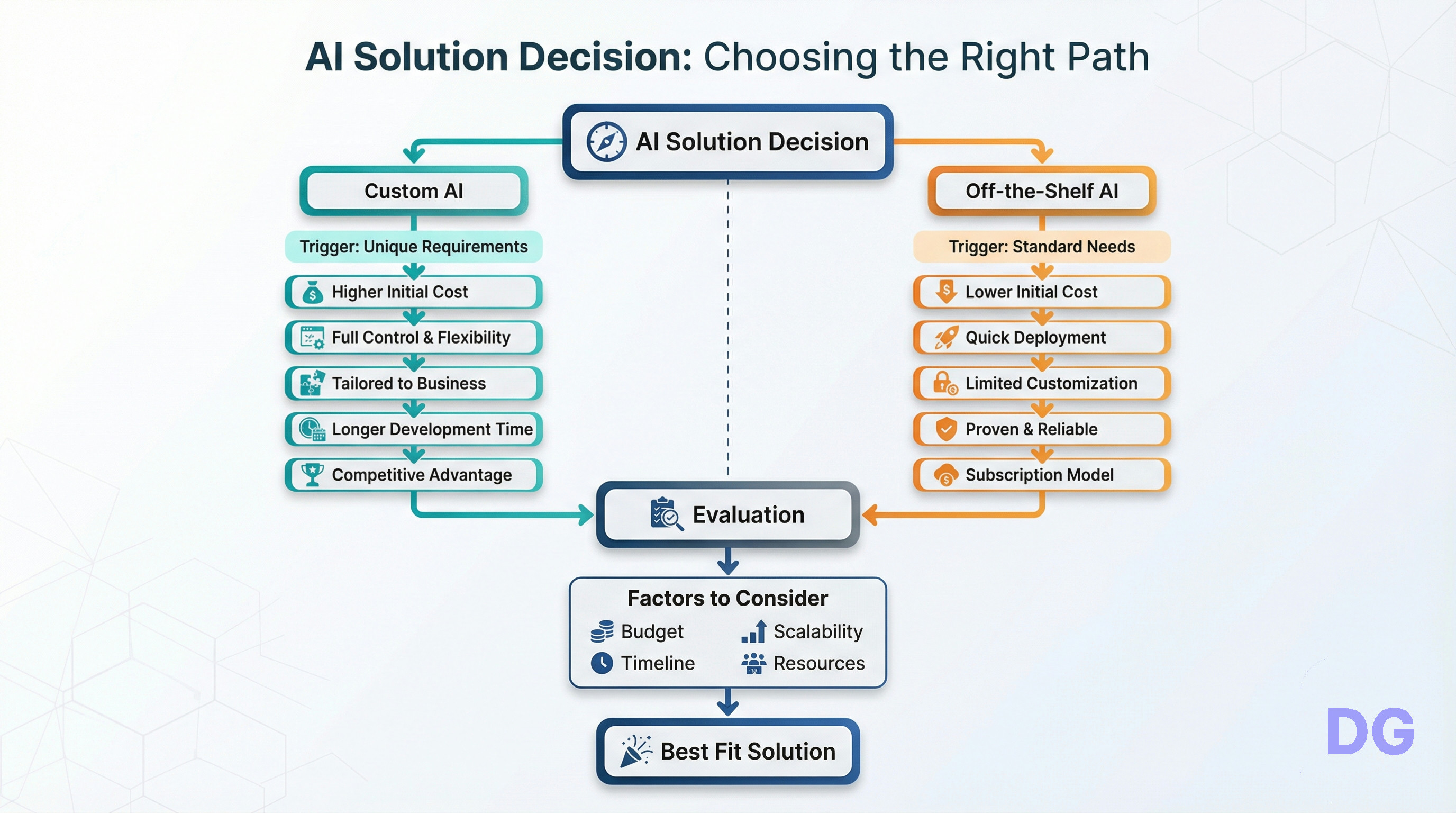
Understanding the differences between these three options will help you decide where an AI consultant fits into your strategy.
| Criteria | AI Consultant | AI Vendor (SaaS) | Internal AI Team |
|---|---|---|---|
| Customisation | Fully tailored to your business | Limited to platform capabilities | Fully custom but slower to build |
| Cost Structure | Project-based or retainer | Monthly subscription | Salaries, infrastructure, ongoing |
| Time to Value | 4–12 weeks for first results | Days to weeks (if it fits) | 6–18 months to build capability |
| IP Ownership | You own everything | Vendor owns the platform | You own everything |
| Scalability | Scales with engagement | Scales with subscription tier | Scales with hiring |
| Domain Expertise | Brings cross-industry insight | Generic, industry-agnostic | Deep but narrow |
| Best For | Businesses starting AI journey or tackling complex, custom problems | Standardised use cases with proven SaaS solutions | Organisations with long-term, ongoing AI needs and budget for a dedicated team |
Most businesses benefit from starting with a consultant to define their strategy and build their first solutions, then gradually transitioning to an internal team as their AI maturity grows.
Here's a practical checklist to guide your search:
Choosing an AI consultant isn't a procurement exercise — it's a partnership decision. The right consultant becomes an extension of your team, someone who understands your business as deeply as they understand the technology and who is genuinely invested in your outcomes.
Focus on business results, not technology buzzwords. Look for honesty over hype, delivery over promises, and partnership over transactions. The AI landscape will keep evolving, but the fundamentals of a good consulting relationship remain the same: trust, transparency, and a relentless focus on value.
Ready to explore what AI can do for your business? Start with a free discovery call — no pressure, no jargon, just an honest conversation about your goals.